

Visit us
Our Location
An idyllic getaway from the city – without travelling too far – Bakernes Paradis is in Lauvvik, a 20-minute drive from Sandnes city center and a 40-minute drive from Stavanger. If you plan to reach us by boat, it takes about 40 minutes to reach us from Sandnes and 45 minutes from Stavanger.
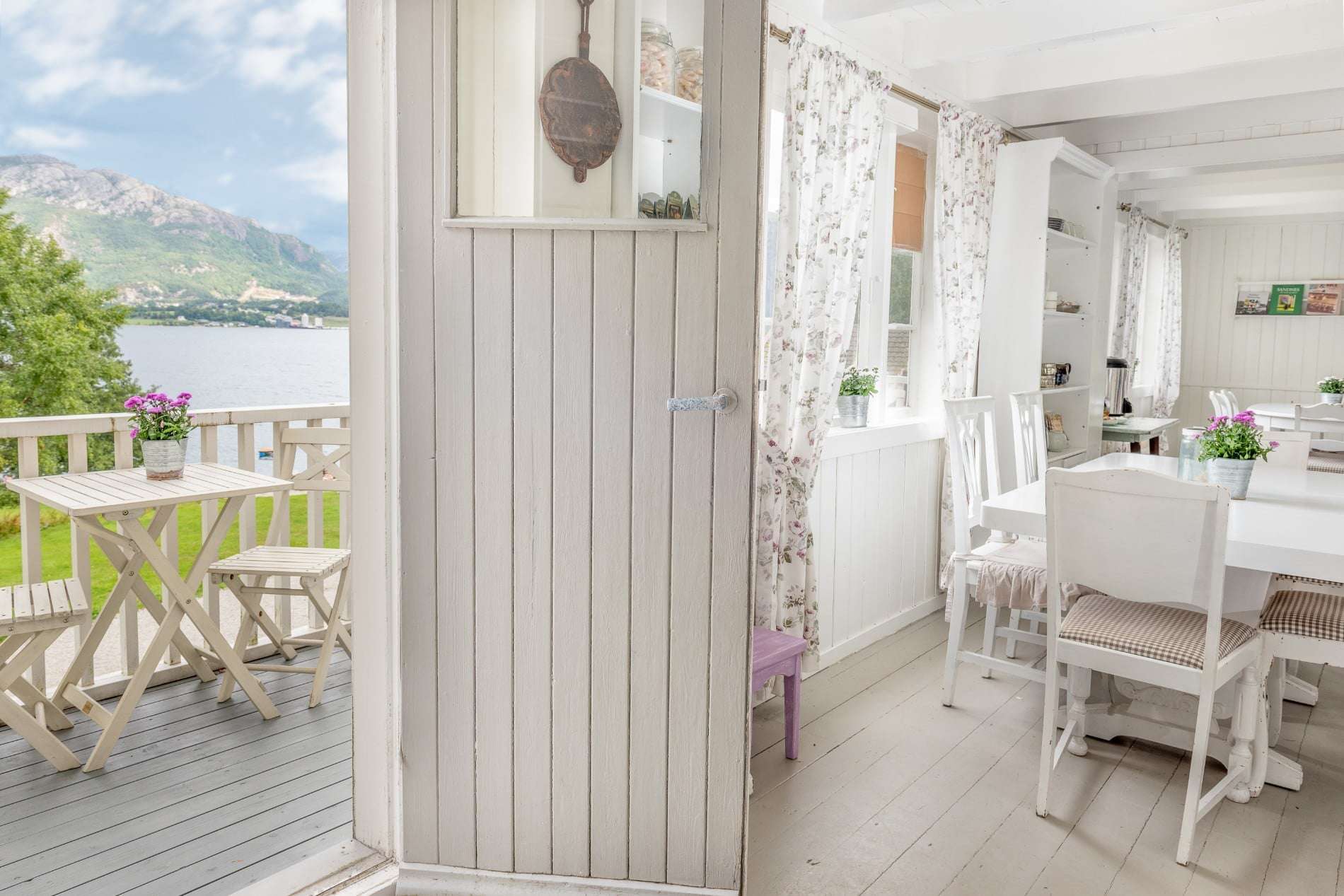
Our café in Heimahuset offers light serving such as our homemade fish soup, toasted sandwiches, baked goods, as well as homemade brownies and carrot cake from Kronen Gaard Hotell.
Our shop, located on the second floor of Heimahuset, offers a variety of unique handmade products and gift items.
Although we do not have accommodation available at Bakernes Paradis, the beautiful and historic Kronen Gaard Hotell in Sandnes is only 22.6 km or a 23-minute drive away.
Our story
Bakernes Paradis
Heimahuset was built in the early 1800s and was originally a tenant farm under Selvig farm, which at the time was a large estate with many associated tenant holdings. The old name of the area is Selvig.
Over time, the house was extended by about one third, and the central part of the roof was raised. There was also once a barn where the Løa stands today. The Løa has since been completely rebuilt by the bakers, who used it as a gathering house, popularly called the “Bingo House.”
The tenant farmer at Selvig was Hans Thoresen Løvig. He inherited the holding and position from his father, who had also been a tenant farmer here. Hans married Anna Thormodsdatter Ims, who came from Ims. Together they had seven children, although their youngest son died at birth. Anna passed away in 1878 at the age of 41, when their youngest child was four years old.
The following year, Hans remarried 18-year-old Berta Endresdatter Ådnøy, who came from Ådnøy. Together they had five children, meaning Hans had a total of 11 living children to provide for. Hans died in 1892, when his youngest daughter Ingeborg was just one year old.
Their son, Hans Bartenius Løvig, later left for America with his mother Petra and his siblings. They travelled by ship from Kristiansand and arrived in New York on 5 May 1909, later settling in Ohio, where two of the older brothers, Rasmus and Reinert, had already emigrated in 1886.
Hans went from being a tenant farmer in Norway to becoming a farmer in America, which at the time carried a higher social status. His mother returned to Norway in 1920 and passed away in 1940, and is buried in Høle.
The family did well in America, and descendants have returned to Norway several times. We have also welcomed visits since Bakernes Paradis was established. The descendants have extensive knowledge of their ancestors and show great interest in the restoration and development of the old tenant farm.
Between 1922 and 1926, the bakers built Litlahuset and Reisehuset. They also renovated existing houses and barns, and constructed the pier. The houses were converted into small living units for the families, and the site could accommodate up to 11 families at the same time.
Life here was simple and good. Meals were prepared on portable stoves, and the bakers enjoyed long summer days by the fjord. The local boat was arranged to stop at the pier for an extra fee, and was also used by holiday guests staying in the surrounding summer houses.
The bakers had their own rowing boats, which they used for fishing, trips, and shopping in Høle. Milk was collected from nearby farms. They also planted berry bushes and fruit trees, which was common for townspeople spending summers in the countryside.

There are many stories about the good life, togetherness, joy, intrigue, romance, and play. It is often the children’s perspective that emerges in conversations with people who experienced summer memories from the place. The experiences are many and varied, stretching back almost 100 years in time.
What has remained constant through all these years is that children from neighbouring farms and summer houses were naturally drawn to the bakers’ holiday retreat. There was always life and activity here, and it was an exciting place to be. The bakers hosted bingo in the barn and occasional dances in the courtyard. Local residents and holiday guests would often drop by. What remains is the feeling of childhood summers and simple joys.
War comes to Stavanger
Most of the bakers worked at the bakery Samhold, located in the eastern part of Stavanger. Many also lived in the surrounding area of Storhaug.
On 9 April 1940, Stavanger was occupied by German troops, and the city was filled with tanks and soldiers. Two days later, on 11 April, a British bomber was shot down and clipped Storhaug School and surrounding buildings. The school burned down together with six nearby residential houses. Fortunately, no children were in the school, but three people were killed and many were seriously injured. All six British airmen in the aircraft died instantly. The war had become a reality, and radio cars drove through the city advising people to move to the countryside for safety.
The bakers gathered their children and families and went to Lauvvik. During this period, more than 60 people stayed at the site. There was unrest and uncertainty, as fighting also took place in the fjord leading towards Dirdal. There was heavy bombing at sea from Helle and inland, and rumours spread that a submarine was hiding in the area. The fighting peaked around the events at Gloppedalsura on 22 April 1940.
Once again, we hear the story from a child’s perspective, this time marked by anxiety and fear. People in Selvikvåg experienced windows shattering from the explosions, leaving lasting impressions on young minds. Children also sensed that the adults were keeping secrets that could not be spoken aloud. Nothing was said openly, but everyone knew that something was happening.
At the time, residents were required to report how many fruit trees they had and the size of their harvest, which was to be delivered to the Germans. The townspeople at Lauvvik therefore smuggled fruit away in rowing boats at night to secure food for their families.
Uburen
According to legend, children were once thrown from the cliffs of Uburen. In earlier times, young unmarried women who gave birth in secrecy would sometimes take the lives of their newborns out of fear of the shame associated with it. At that time, it was considered a grave sin to have a child under such circumstances.
It is said that the Utburd would often make itself known by crying out, and was therefore also called the “Roper” (the caller). According to folklore, the Utburd could take many forms and might attach itself to the back of anyone passing by its burial place. Because it was not baptised, it was believed to have no place in heaven.
Some people sought to give their infants peace by naming them before they were taken. A common practice was to use wordplay instead of formal baptism. This could be done in ways such as
“I baptise you in hope – either Kari or Jon.”
And then all one could do was hope for the best.
The bakers’ children in Lauvvik heard many frightening stories about this, but they mostly enjoyed competing to see who could spot the goat in Uburen. On the face of the mountain, a large goat-like face can be seen.
Norwegian tradition and culture
We have a dream
We call the place Bakernes Paradis, inspired by the stories we have heard about the bakers’ children’s summer paradise.
Our vision is to bring these stories to life through our actions and the concepts we create, as well as to restore the houses as faithfully as possible to the period in which they were built.
We aim to share Norwegian tradition and culture, tourism, and meaningful experiences for business guests, travellers, and private visitors alike.
We look forward to welcoming you!
The perfect location for
Private events, courses, and meetings
For us, the most important thing is to create a day filled with lasting memories, where you can relax and enjoy good food in beautiful surroundings. Every year we renovate and improve the old buildings here in Lauvvik. There is still a lot of work to be done at Bakernes Paradis. A lot. We are excited to continue the journey!
The old local boat once called at the pier in Lauvvik on its route towards Selvikvåg, Oltesvik, Dirdal, and Frafjord. We have now reopened this deep-water pier. We are ready to welcome both small and large boats.
Perfect for unconventional meetings!
Would you like to host a different kind of meeting in peaceful and beautiful surroundings? We offer great facilities.
For pre-booked groups, private events, and arrangements, please contact us at [email protected].


Discovery Route
The Discovery Route is a historic round-trip journey along Road 13 (Rv.13) through Fjord Norway, from Stavanger to Bergen. This historic route has existed since the 1880s, when travellers explored the region by horse and carriage to experience its stunning landscapes of majestic mountains, dramatic fjords, glaciers, crystal-clear rivers, and roaring waterfalls.
Along the Discovery Route, you can stay at historic hotels and visit popular attractions such as Preikestolen and Trolltunga. Book your holiday in Norway through Up Norway, which has extensive experience in creating tailor-made travel experiences designed around your wishes and needs.
Norway’s most sustainable journey
In the summer of 2020, Ina Vikøren, Sustainability Manager at Telia, travelled with Up Norway and a film crew along the historic Discovery Route between Bergen and Stavanger. Along the way, they met local tourism providers such as Kronen Gaard Hotel and our country estate Bakernes Paradis.
The goal of the journey was to design and explore what could become Norway’s most sustainable travel experience.


